How to Tell if a Document Is Peer Reviewed

When you write a peer review for a manuscript, what should y'all include in your comments? What should you leave out? And how should the review be formatted?
This guide provides quick tips for writing and organizing your reviewer study.
Review Outline
Apply an outline for your reviewer written report and so it's easy for the editors and author to follow. This will also help you keep your comments organized.
Retrieve near structuring your review like an inverted pyramid. Put the most important information at the peak, followed by details and examples in the center, and any additional points at the very lesser.
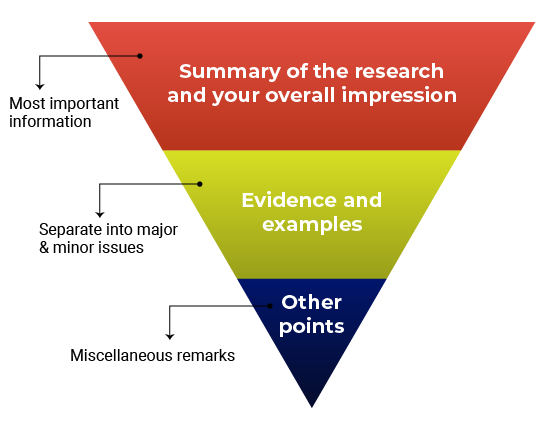
Here's how your outline might expect:
ane. Summary of the enquiry and your overall impression
In your own words, summarize what the manuscript claims to report. This shows the editor how you interpreted the manuscript and will highlight any major differences in perspective between you and the other reviewers. Give an overview of the manuscript's strengths and weaknesses. Think most this every bit your "accept-home" message for the editors. End this section with your recommended course of activeness.
2. Discussion of specific areas for improvement
It'due south helpful to dissever this section into two parts: one for major issues and one for pocket-size bug. Inside each section, yous can talk near the biggest issues offset or go systematically figure-past-figure or claim-by-claim. Number each item so that your points are piece of cake to follow (this will besides brand information technology easier for the authors to reply to each indicate). Refer to specific lines, pages, sections, or figure and table numbers so the authors (and editors) know exactly what you're talking nigh.
Major vs. minor problems
What's the departure between a major and pocket-size result? Major issues should consist of the essential points the authors need to address earlier the manuscript can go on. Make sure you focus on what iscentral for the current study. In other words, it's not helpful to recommend boosted work that would be considered the "side by side step" in the study. Minor issues are still important but typically will not bear on the overall conclusions of the manuscript. Here are some examples of what would might go in the "modest" category:
- Missing references (just depending on what is missing, this could too exist a major issue)
- Technical clarifications (e.g., the authors should clarify how a reagent works)
- Data presentation (e.g., the authors should present p-values differently)
- Typos, spelling, grammar, and phrasing issues
3. Any other points
Confidential comments for the editors
Some journals accept a infinite for reviewers to enter confidential comments nigh the manuscript. Use this space to mention concerns about the submission that y'all'd want the editors to consider earlier sharing your feedback with the authors, such equally concerns about upstanding guidelines or language quality. Whatever serious bug should be raised straight and immediately with the periodical as well.
This section is too where you will disclose any potentially competing interests, and mention whether you're willing to look at a revised version of the manuscript.
Exercise non use this space to critique the manuscript, since comments entered here will non be passed along to the authors. If you're not certain what should become in the confidential comments, read the reviewer instructions or check with the journal start before submitting your review. If yous are reviewing for a journal that does not offer a space for confidential comments, consider writing to the editorial office directly with your concerns.
Get this outline in a template
Giving Feedback
Giving feedback is hard. Giving constructive feedback tin be even more challenging. Remember that your ultimate goal is to discuss what the authors would need to do in order to qualify for publication. The signal is not to nitpick every piece of the manuscript. Your focus should be on providing constructive and disquisitional feedback that the authors can use to improve their study.
If you've ever had your own work reviewed, you already know that information technology's not e'er easy to receive feedback. Follow the golden rule: Write the type of review you'd want to receive if you were the author. Even if y'all make up one's mind not to identify yourself in the review, you should write comments that you would be comfy signing your name to.
In your comments, use phrases similar "the authors' discussion of Ten" instead of "your discussion of 10." This will depersonalize the feedback and keep the focus on the manuscript instead of the authors.
Full general guidelines for constructive feedback

Practise
- Justify your recommendation with concrete evidence and specific examples.
- Be specific and then the authors know what they need to do to meliorate.
- Be thorough. This might be the only time you read the manuscript.
- Be professional and respectful. The authors volition be reading these comments too.
- Remember to say what yous liked about the manuscript!

Don't
- Recommend boosted experiments or unnecessary elements that are out of telescopic for the study or for the periodical criteria.
- Tell the authors exactly how to revise their manuscript—yous don't need to do their work for them.
- Use the review to promote your own research or hypotheses.
- Focus on typos and grammer. If the manuscript needs pregnant editing for linguistic communication and writing quality, just mention this in your comments.
- Submit your review without proofreading it and checking everything ane more time.
Before and After: Sample Reviewer Comments
Keeping in mind the guidelines higher up, how do you put your thoughts into words? Here are some sample "before" and "later on" reviewer comments
✗ Before
"The authors appear to have no thought what they are talking about. I don't think they take read any of the literature on this topic."
✓ Later on
"The written report fails to address how the findings chronicle to previous research in this expanse. The authors should rewrite their Introduction and Word to reference the related literature, particularly recently published work such equally Darwin et al."
✗ Before
"The writing is so bad, it is practically unreadable. I could barely bring myself to finish it."
✓ After
"While the study appears to be audio, the language is unclear, making information technology difficult to follow. I advise the authors work with a writing coach or copyeditor to ameliorate the flow and readability of the text."
✗ Before
"It's obvious that this type of experiment should have been included. I take no thought why the authors didn't employ it. This is a big fault."
✓ After
"The authors are off to a practiced first, however, this study requires additional experiments, particularly [type of experiment]. Alternatively, the authors should include more than information that clarifies and justifies their choice of methods."
Suggested Language for Tricky Situations
Y'all might find yourself in a state of affairs where you're not sure how to explain the problem or provide feedback in a constructive and respectful mode. Here is some suggested language for common issues you might experience.
What you call back: The manuscript is fatally flawed.
What you could say: "The study does not appear to be sound" or "the authors accept missed something crucial".
What you call back: You don't completely empathise the manuscript.
What you lot could say: "The authors should clarify the following sections to avert defoliation…"
What y'all think: The technical details don't make sense.
What you could say: "The technical details should be expanded and antiseptic to ensure that readers sympathize exactly what the researchers studied."
What you think: The writing is terrible.
What you could say: "The authors should revise the linguistic communication to amend readability."
What you recall: The authors have over-interpreted the findings.
What you could say: "The authors aim to demonstrate [XYZ], nevertheless, the data does not fully support this determination. Specifically…"
What does a good review wait like?
Check out the peer review examples at F1000 Research to see how other reviewers write upwards their reports and give constructive feedback to authors.
Fourth dimension to Submit the Review!
Be sure you turn in your report on fourth dimension. Need an extension? Tell the journal so that they know what to wait. If you demand a lot of actress fourth dimension, the journal might need to contact other reviewers or notify the writer about the delay.
Tip: Building a relationship with an editor
You'll exist more than likely to be asked to review again if you provide loftier-quality feedback and if yous turn in the review on time. Specially if it'south your first review for a journal, it'southward important to show that y'all are reliable. Show yourself in one case and you'll become asked to review again!
Related Resource
-
How To How to Choose the Journal That's Right for Your Written report
There's a lot to consider when deciding where to submit your work. Learn how to choose a periodical that will assist your study reach its audience, while reflecting your values as a researcher…
Read more
-
How To How to Write Discussions and Conclusions
The word department contains the results and outcomes of a study. An constructive give-and-take informs readers what tin be learned from your…
Read more
-
How To How to Study Statistics
Ensure appropriateness and rigor, avert flexibility and above all never manipulate results In many fields, a statistical analysis forms the middle of…
Read more than
reaganfrearraprou.blogspot.com
Source: https://plos.org/resource/how-to-write-a-peer-review/
0 Response to "How to Tell if a Document Is Peer Reviewed"
Post a Comment